







Why We Tell Saskatoon Homeowners to Turn Off Their AC Before Calling for 24-Hour Repair


Why Your First Instinct During an AC Breakdown Could Be Costly
At Efficiency Heating & Cooling, we are frequently asked exactly why we tell Saskatoon homeowners to turn off their AC before calling for 24-hour repair when the house is already uncomfortably hot. The vents are barely blowing air, the thermostat keeps climbing, and your immediate instinct is to drop the temperature setting by five degrees to force the system to work harder. During a severe mid-summer heatwave in late July or August, indoor temperatures in Saskatoon can skyrocket rapidly, making this sense of panic a completely natural response. However, our team constantly reminds customers that lowering the thermostat is the absolute worst action you can take if your air conditioner is failing due to a frozen evaporator coil.
For comprehensive Air Conditioning Services or when you know you need 24-hour emergency AC repair, shutting down the cooling cycle is the crucial first step to protect your system.
When an air conditioner stops cooling suddenly, a solid block of ice inside the unit is often the primary culprit. Continuing to run the system will not cool your home. Instead, it forces the outdoor unit to work under extreme duress, risking catastrophic mechanical failure. Turning the system completely off is not giving up to the heat; it is a vital, active measure you must take to protect your equipment before our emergency technicians arrive at your door.
What Happens When Your AC Coil Freezes Solid?
Our technicians often explain to homeowners that to understand why a frozen system is so dangerous, you have to look at the basic mechanics of how your air conditioner actually works. Whether you have an older R-22 system or a modern R-410A unit, your AC does not create cold air out of nowhere. Instead, it removes heat from the air inside your home. When this delicate balance of airflow and heat absorption is disrupted, temperatures drop too low, and ice begins to form.
The Role of the Evaporator Coil in Your HVAC System
The evaporator coil is a network of copper tubes located inside your indoor air handler or above your furnace. Inside these tubes, cold liquid refrigerant circulates. As warm air from your house blows over the coil, the refrigerant absorbs the heat and boils into a gas. This heat exchange process requires a constant, steady volume of warm indoor air moving across the metal fins.
If that continuous airflow is restricted, the heat exchange stops. The refrigerant inside the coil stays incredibly cold, causing the temperature of the metal itself to drop well below the freezing point.
How Ice Buildup Chokes Your Airflow
Your indoor air naturally contains humidity. When warm, humid air hits a freezing-cold evaporator coil, condensation forms on the metal—just like water droplets on a cold glass of iced tea. Under normal conditions, this water drips safely into a drain pan. But when the coil temperature drops below freezing due to restricted airflow (often caused by a heavily clogged filter) or low refrigerant levels, that condensation freezes instantly.
This creates a dangerous chain reaction:
• Initial frost: A thin layer of ice forms on the copper coils.
• Insulation effect: Ice acts as an insulator, preventing the refrigerant from absorbing any remaining heat from the air.
• Rapid freezing: Because no heat is being absorbed, the coil gets even colder, freezing more condensation.
• Total blockage: The ice bridges the gaps between the metal fins, forming a solid block that completely blocks airflow.
Once the coil is encased in a block of ice, the system can no longer cool your home, regardless of how low you set the thermostat. You might notice weak, warm airflow from your vents or even see visible ice building up on the copper refrigerant lines outside near your compressor.
The Hidden Danger of Liquid Slugging on Your Compressor
In our years of servicing Saskatoon HVAC equipment, we've found the primary reason you must turn off a frozen air conditioner immediately comes down to one highly technical, highly destructive event: liquid slugging. This phenomenon is the fastest way to destroy the most critical and expensive component of your entire cooling system.
Why Compressors Cannot Compress Liquid
The compressor, located inside the outdoor unit, acts as the heart of your air conditioning system. Its sole job is to pump refrigerant through the lines. By design, modern scroll compressors—which are standard in most 13 to 16 SEER units—are built to compress gas. Gases can be squeezed into a smaller volume, which increases their pressure and temperature before sending them to the condenser coil to release heat outside.
Liquids, on the other hand, cannot be compressed. If you put water into a sealed cylinder and try to crush it, the cylinder will break before the water compresses. The same physics apply to your AC compressor.
When your indoor evaporator coil freezes solid, the heat exchange process stops. Because no heat is absorbed, the cold liquid refrigerant never boils into a gas. Instead, it remains a liquid and travels backward down the suction line directly into the compressor.
The Cost of Catastrophic Compressor Failure
When liquid refrigerant enters the compressor, it causes "liquid slugging." The mechanical pistons and scroll plates inside the compressor slam into an incompressible liquid at high speeds.
The symptoms of liquid slugging include:
• Loud, aggressive knocking or banging noises from the outdoor unit.
• Violent shaking or vibration of the compressor housing.
• Internal valves shattering under the extreme mechanical stress.
• The compressor motor burning out due to sudden electrical overload.
A destroyed compressor is rarely a minor fix. In many cases, especially with systems older than ten years, a failed compressor leads to a complete system replacement. By simply turning the thermostat to "Off" the moment you realize the system is frozen, you actively protect this vital component from tearing itself apart.
Immediate Steps to Take Before the Technician Arrives
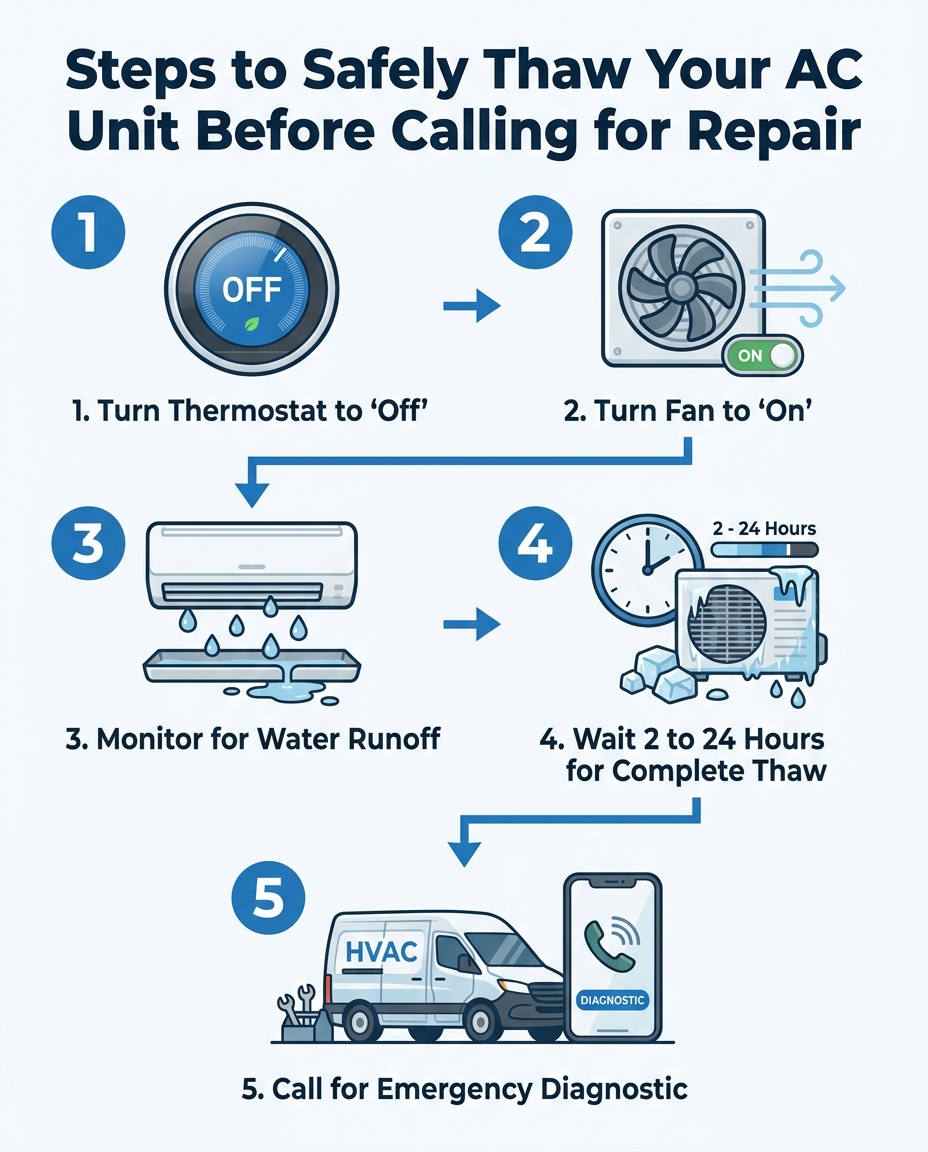
When a customer calls our dispatch line with these symptoms, we walk them through a specific protocol. If you notice weak airflow, warm air coming from the vents, or visible ice on your refrigerant lines, you need to take immediate action to stabilize the equipment. Follow these exact steps to initiate the thawing process safely before you contact a professional for air conditioner repair.
1. Turn the cooling cycle off: Go to your thermostat and switch the primary system setting from "Cool" to "Off." This stops the outdoor compressor from pumping cold refrigerant into the frozen indoor coil.
2. Turn the system fan on: Switch the fan setting on your thermostat from "Auto" to "On." This forces the indoor blower motor to run continuously, circulating warm indoor air over the frozen coil to accelerate the thawing process safely.
3. Check the filter: While you wait, pull out your furnace filter. Standard 1-inch pleated filters (MERV 8 or higher) can clog in just 30 to 60 days during peak summer usage. If it looks like a solid blanket of gray dust, that severe airflow restriction might be the root cause of the freeze. Leave the dirty filter out while the system thaws to maximize airflow.
4. Monitor for water runoff: A solid block of ice translates to a massive amount of water once it melts. Keep an eye on the indoor unit to ensure the condensate drain pan does not overflow and cause water damage to your floor or furnace components. Have towels ready just in case the drain line is clogged.

Why We Cannot Diagnose a Block of Ice
One of the most frustrating things for a homeowner during a mid-summer heatwave is being told they have to wait before a repair can be completed. However, our team always emphasizes that there is a strict logistical reality to emergency HVAC service: a technician cannot accurately diagnose or repair a system while the evaporator coil is encased in a solid block of ice.
To find the root cause of the breakdown, an HVAC technician needs to connect specialized gauges to the system to test refrigerant pressures. They also need to measure the temperature drop across the indoor coil and check the velocity of the airflow. These critical diagnostic tests are physically impossible to perform when the coil is frozen.
If a technician arrives while the unit is still frozen, they will have no choice but to turn the system off and wait for it to thaw. Waiting for a unit to melt while a technician is standing in your basement wastes your valuable time. We advise you to turn the unit off immediately because we prioritize your equipment's safety and your long-term costs over rushing out just to charge a diagnostic fee on an unworkable unit.
One Saskatoon homeowner in the Stonebridge neighborhood called us during a Friday heat wave when temperatures hit +30°C and their older 10 SEER AC unit stopped cooling entirely. Because they had already turned the system off to let it thaw before we arrived, the unit was ready for service. The technician was able to properly test the system, perform the necessary immediate repair, and even quickly source an additional part to improve the older unit's performance—without wasting hours waiting for ice to melt.
How Long Does It Take for an AC Coil to Thaw?
We generally advise our customers that patience is required when dealing with a frozen air conditioner. Depending on the severity of the ice buildup, a complete thaw on a standard 2.5-ton to 3-ton system can take anywhere from 2 to 24 hours.
Factors Influencing Thaw Time
The thickness of the ice block is the primary factor. A light coating of frost might melt in a few hours, while a coil encased in inches of solid ice will take much longer. The ambient temperature inside your home also plays a significant role; warmer indoor air will melt the ice faster. This is why leaving the system fan switched to "On" is so crucial—it constantly feeds warm air over the frozen metal, significantly speeding up the process.
• Light Frost — Fan Setting: Fan ON — Estimated Thaw Time: 2 to 4 Hours
• Moderate Ice Buildup — Fan Setting: Fan ON — Estimated Thaw Time: 4 to 8 Hours
• Solid Block of Ice — Fan Setting: Fan OFF (Passive thaw) — Estimated Thaw Time: 12 to 24+ Hours
Why You Shouldn't Rush the Process
It is incredibly tempting to try and speed up the thawing process yourself, but DIY methods often lead to disaster. Never use hair dryers, heat guns, or space heaters near the indoor coil, as the extreme, concentrated heat can melt internal plastic components or damage the electrical wiring.
More importantly, never use sharp objects like knives, screwdrivers, or ice picks to chip away the ice. The copper tubing in your evaporator coil is incredibly delicate. A single slip can puncture the coil, releasing all your refrigerant into the atmosphere and turning a simple repair into an expensive coil replacement. Patience is the only safe method.
What to Expect From True 24-Hour Emergency Response
Once you have safely powered down the cooling cycle and the system is thawing, you can breathe a little easier knowing that the worst risk to your compressor has been mitigated. From there, the Efficiency Heating & Cooling 24-hour emergency response team will be ready to step in and resolve the root cause.
You will not be left stranded in the heat. When the technician arrives at your home, they will come prepared to inspect the entire system comprehensively. They will look for dirty filters, test for slow refrigerant leaks, evaluate the blower motor's performance, and check the ductwork for major blockages. Evaluating the overall system health prevents future breakdowns and ensures you aren't just getting a temporary band-aid fix.
For example, another local customer in the Evergreen neighborhood reached out to us when their AC went down in the middle of summer. Because they followed the correct shutdown steps and the system was ready for service upon arrival, the unit was diagnosed and fixed ASAP, keeping their home cool and comfortable for the rest of the season. Getting a professional evaluation is also a great time to review resources like a Furnace Size Guide for Saskatoon Homes if you are considering upgrading your entire HVAC system in the near future.
Frequently Asked Questions About Frozen AC Units
Should I turn off my AC if it's freezing up?
Yes, our emergency dispatchers always advise turning off the cooling function immediately if your AC is freezing up. Continuing to run a frozen air conditioner forces the compressor to work against a solid blockage, which can lead to severe mechanical damage. Switch the thermostat to "Off" to stop the cooling cycle, but leave the fan switched to "On" to help circulate warm air and melt the ice safely.
How long does an AC take to unfreeze?
An air conditioner typically takes between 2 and 24 hours to unfreeze completely. The exact timeframe depends heavily on how thick the ice has become and the ambient temperature inside your home. Running the indoor blower fan continuously will significantly reduce the time it takes for the ice to melt.
Why is my AC running but not blowing cold air?
If your AC is running but blowing warm air, a frozen evaporator coil is a highly likely cause. When the coil freezes solid, air cannot pass through the icy blockage to be cooled, resulting in weak, warm airflow from your vents. Other potential causes include a failed compressor, a severe refrigerant leak, or a tripped breaker on the outdoor unit.
What happens if you keep running a frozen air conditioner?
Running a frozen air conditioner will eventually destroy your compressor through a process called liquid slugging. Because the frozen coil cannot absorb heat, the liquid refrigerant never turns into a gas and flows backward into the compressor. Compressors are built to pump gas, not liquid, and the resulting mechanical stress will shatter internal valves and burn out the motor.
Can I just leave the fan on if my AC is frozen?
Yes, leaving the fan on is the best step you can take after turning the cooling cycle off. Switching the thermostat fan setting from "Auto" to "On" forces the indoor blower motor to run constantly. This pulls warm air from your home and blows it over the frozen coil, which safely and effectively accelerates the melting process without risking damage to the equipment.
Ready for a Diagnosis? Contact Your Local Saskatoon Experts
At Efficiency Heating & Cooling, understanding why we tell Saskatoon homeowners to turn off their AC before calling for 24-hour repair is all about protecting your long-term investment. Whether you are running a 15-year-old single-stage unit or a brand-new variable-speed system, shutting down the cooling cycle and turning on the fan is the vital first step to save your compressor. However, a professional diagnostic is the final solution to keep the ice from coming back.
Once you have stabilized your system and the thawing process has begun, do not wait for the heat to overwhelm your home again. Schedule your emergency service visit with Efficiency Heating & Cooling so our technicians can be dispatched to find and fix the root cause the moment your unit is workable. We are committed to providing clear, calming reassurance and expert repair when you need it most.


Customer Testimonials
Hear what our satisfied customers have to say about their experiences with us.
I had my furnace decided to act up in the evening, of course. They sent out a tech that night and he was able to get to going till a new part could be installed the next day. The next time I need any work done, or service, this is who I am calling! Thanks again.
Dustin was excellent. Quickly diagnosed and corrected the problem I had with my furnace. Proactive and efficient worker with excellent communication. Took the time to see if I had any other questions or concerns. Highly recommend!!
I just had Dustin here to do a maintenance on air conditioner. He was so awesome and knowledgeable. I would absolutely recommend these guys to anyone. They also did my maintenance on furnace a year ago and was very good and professional at it. High recommend 5 star.
Great Job! Very pleased with the installation of our A/C unit. Installers were very professional - arrived on time, work area was cleaned up when they were finished, explained what they had done and ensured that we understood how the installation worked before they left.
Overall very good service, both after hours and during regular hours. Managed to schedule me in promptly to have my furnace replaced. The technicians mislabeled the zones on the thermostat, however overall very happy with the install. Will definitely be a returning customer.
they were sent on behalf of North Prairie Rentals. I was kept up to date and the gentleman that came was knowledgeable and friendly.
Had my water heater replaced. Carter had only been with the company for 6 months but proved to be very thorough and careful. He checked for gas leaks several times, readily replaced old parts and explained lighting procedure. I was very pleased with his workmanship.
Started with a furnace checkup which quickly turned into a discussion about a new furnace. Received an honest explanation of problems and reasons for purchasing a new furnace rather than fixing old one. Fast efficient service upon installation. Very happy with customer service!
My husband and I had Jason from Efficiency come out to fix a couple of gas leaks. We were very happy with the work he did. He was knowledgeable and took the time to answer all of our questions. We highly recommend! We will definitely be booking with Efficiency for our future needs due to Jason’s outstanding customer service!
We had a furnace installed recently. The guys at EH&C did a super job. They described how the install would go, answered all our questions, proceeded quickly and efficiently. Very pleased.