







What Actually Happens Inside Your Gas Fireplace After Sitting Unused All Summer

The Hidden Impact of Summer on Your Gas Fireplace
Here at Efficiency Heating & Cooling, we know that late August in Saskatoon means the sudden shift from hot, dry summer days to shockingly chilly evenings is just around the corner. This is exactly when you might discover what actually happens inside your gas fireplace after sitting unused all summer. You walk over to flip the wall switch or press the remote button, expecting instant, comforting warmth, but absolutely nothing happens. The pilot light refuses to ignite, or the flames sputter weakly and die out within seconds. Because modern gas fireplaces do not produce massive piles of wood ash, soot, or creosote in the same way traditional wood-burning hearths do, it is incredibly common for homeowners to assume these systems are entirely maintenance-free. However, our team frequently sees how months of extended dormancy allow microscopic debris, household dust, and pet dander to settle deep inside the unit's most sensitive mechanical components, leading directly to mysterious ignition failures right when you need the heat the most.
Right now, you face a critical decision point regarding your home comfort. You can choose to test the system early and schedule preventive care, or you can wait until the first truly freezing night of early autumn and risk being left with a cold living room and no supplemental heat. By addressing this hidden seasonal impact proactively, you protect your comfort and avoid the frustration of a malfunctioning system. For comprehensive support with your home's climate, explore our heating services.
The Reality of Seasonal Dormancy
Many homeowners misunderstand what happens to their heating equipment during the off-season. Based on what we see in the field every year, here is a breakdown of how different fireplace types react to summer downtime:
• Traditional Wood-Burning — Common Assumption: Needs sweeping to remove heavy soot and creosote. — The Hidden Summer Reality: Birds or pests may build large nests in the open chimney flue. — Early Autumn Consequence: Smoke backs up into the living room upon the first lighting.
• Vented Gas Fireplace — Common Assumption: Maintenance-free because there is no visible ash. — The Hidden Summer Reality: Microscopic dust settles on delicate electrical sensors like the thermocouple. — Early Autumn Consequence: The pilot light fails to stay lit, or the main burner refuses to ignite.
• Gas Insert — Common Assumption: Completely sealed and immune to seasonal changes. — The Hidden Summer Reality: Spiders enter through exterior venting to nest in dormant burner tubes. — Early Autumn Consequence: Uneven, sputtering flames or immediate safety shutoffs.
The Silent Culprit: How Microscopic Dust Blocks Your Thermocouple
When you encounter a gas fireplace that simply refuses to stay lit in late August or early autumn, the problem almost always traces back to a tiny, highly sensitive component called the thermocouple (or thermopile, depending on your specific unit). Our Efficiency Heating & Cooling technicians respond to hundreds of these exact calls every fall, and the pattern is highly predictable: you light the pilot, hold the knob down as instructed, but the moment you release it, the flame vanishes. The underlying cause is rarely a broken part, but rather a physical barrier created by months of microscopic summer dust.
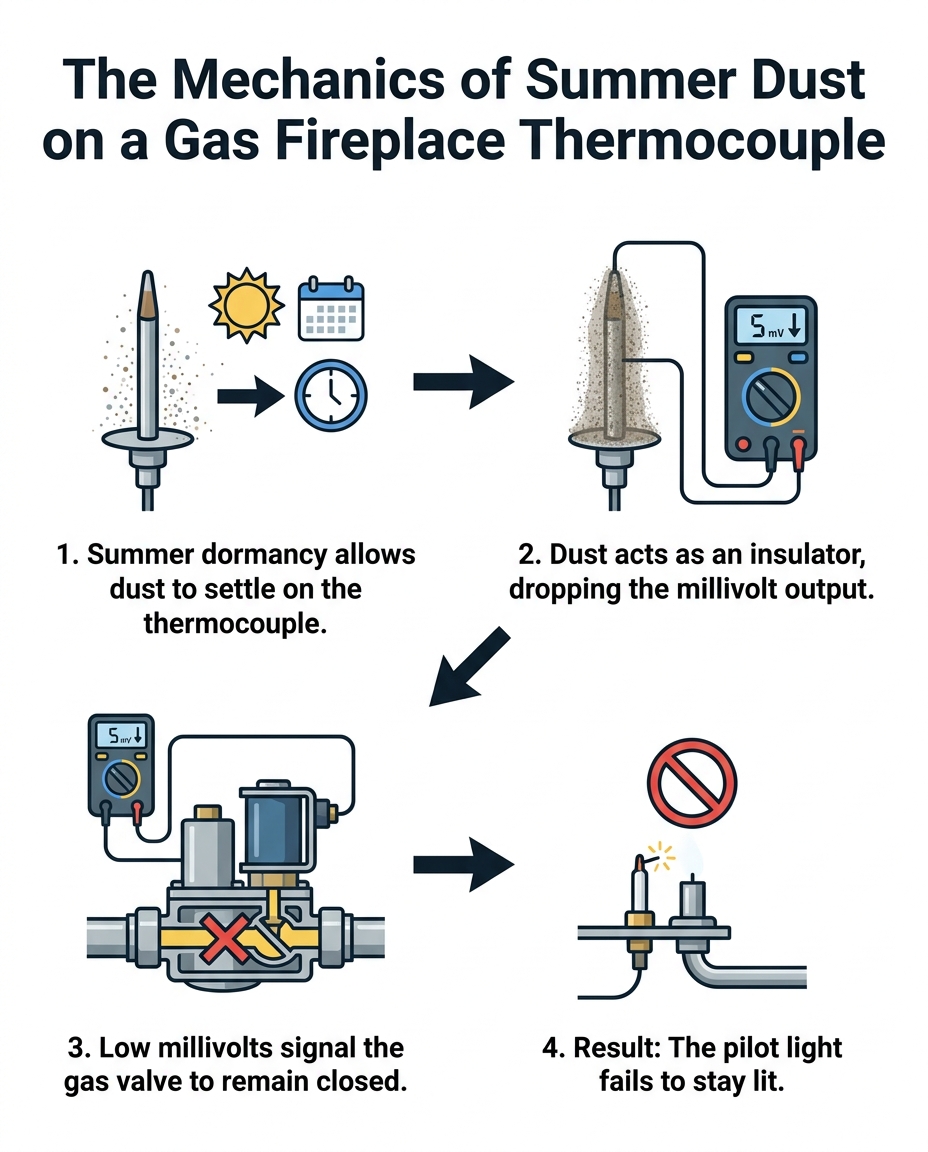
The thermocouple is a small metal sensor that sits directly in the path of the pilot flame. Its sole job is to generate a tiny electrical current when heated. This current signals the main gas valve to stay open, proving that a flame is present and it is safe to release natural gas into the burner. During the summer, an invisible layer of household dust settles over this sensor. Dust acts as a highly effective thermal insulator. When you finally try to start the fireplace, the pilot flame hits the dust layer instead of the metal sensor, preventing the thermocouple from getting hot enough to generate the required electricity. The solution is removing this physical barrier, which is exactly why our team highly recommends scheduling professional fireplace repair and maintenance before the cold weather sets in.
Understanding the Millivolt Drop
To truly grasp why your fireplace is failing, you have to look at the math behind the mechanics. The electrical current we are talking about is incredibly small—measured in millivolts (thousandths of a volt).
• The Baseline Requirement: A standard gas valve relies on a very specific, steady millivolt reading to hold the internal safety magnet open.
• The Insulating Effect: Even a fraction of a millimeter of household dust, pet hair, or airborne cooking oils disrupts this delicate heat transfer.
• The Safety Shutdown: If the millivolt reading drops even slightly below the required threshold, the safety mechanism assumes the pilot flame has blown out. The valve snaps shut instantly to prevent raw gas from flooding your living room.
This is a brilliant safety feature, but it is also the primary reason your fireplace won't start after a long summer sleep.

Unwanted Summer Guests: Why Spiders Love Dormant Gas Lines
While dust is the most common culprit behind ignition failure, there is a secondary, lesser-known issue that frequently plagues homeowners in Saskatoon after a long, quiet summer. In our experience servicing local gas appliances, we frequently find that unwanted pests, specifically spiders and small insects, seek out dormant gas lines and burner tubes as ideal nesting grounds. You might wonder why a spider would choose a metal tube that smells like natural gas over a dark corner of your basement.
The science behind the attraction: Natural gas is naturally odorless. Utility companies add a chemical called mercaptan to give it that distinct, rotten-egg smell so leaks can be easily detected. Interestingly, certain species of spiders are highly attracted to the specific chemical composition of mercaptan odorants. During the summer, when the fireplace is completely turned off and the gas is not actively flowing and burning, these spiders crawl into the main burner tubes and pilot assemblies to spin dense, thick webs.
A single, tightly woven spider web is surprisingly strong. It can easily disrupt the precise flow of gas and oxygen required for a clean burn. When you attempt to turn the fireplace on, this blockage forces the gas to back up or mix improperly, causing sputtering, uneven yellow flames, delayed ignition (a small "poof" sound when lighting), or complete pilot failure. Because this issue is entirely unique to extended summer downtime, it catches many homeowners completely off guard.
Beating the Late August Fireplace Rush
The transition from summer to autumn in our region is rarely a slow, gentle glide. Instead, we frequently experience a rapid late-August temperature drop where daytime highs suddenly give way to nighttime lows in the single digits (Celsius). This sudden chill acts as a universal alarm clock for Saskatoon homeowners, prompting everyone to test their heating equipment on the exact same evening.
In our years of restoring warmth to local homes, the Efficiency Heating & Cooling team has seen exactly how this 'late August fireplace rush' unfolds year after year. The sudden spike in service calls creates a backlog, meaning those who wait until their fireplace fails on a freezing night often have to wait for an available technician. By understanding this rhythm, you can position yourself ahead of the curve.
Strategic steps to beat the seasonal rush:
1. Test the system early: Turn on your gas fireplace in mid-August, even if it is still warm outside. Let it run for fifteen minutes to observe the flame quality and ensure the pilot holds.
2. Listen for unusual sounds: Pay attention to any clicking, grinding, or delayed ignition sounds, which indicate built-up debris in the burner.
3. Schedule preventive care before the freeze: Book your seasonal maintenance while the weather is still mild and appointment times are plentiful.
4. Secure your peace of mind: Knowing your supplemental heating is fully operational before the first frost provides immense comfort and eliminates the stress of emergency calls.
The Dangers of DIY: Why Gas Appliance Cleaning Requires a Professional
When you learn that the primary reason your gas fireplace won't start is simply a layer of dust on a sensor or a spider web in a tube, the immediate temptation is to grab a rag, a can of compressed air, or a wire brush and fix it yourself. We strongly advise against this. While wiping down the glass front is perfectly fine, opening the combustion chamber to clean gas lines, valves, or sensors carries extreme safety and fire risks.
The delicate nature of the thermocouple: This sensor is not a robust piece of steel; it is a highly calibrated, fragile instrument. Aggressively scrubbing it with an abrasive pad or wire brush can permanently damage the outer casing, ruining its ability to conduct heat and requiring a complete replacement. Furthermore, if you accidentally bend the pilot assembly even a few millimeters out of alignment, the flame will no longer hit the sensor correctly, leaving you in the exact same position as before.
More importantly, working with gas appliances legally and practically requires a licensed professional. Disturbing gas lines, failing to properly reseal the combustion chamber, or improperly reassembling the burner tubes can lead to slow, undetectable gas leaks or carbon monoxide buildup in your home. As we approach late August and early autumn, the smartest and safest choice is always to leave the internal mechanics to a trained technician.
What to Expect During a Comprehensive Fall Fireplace Inspection
Understanding exactly what happens during a professional service visit helps demystify the process and highlights why it is so valuable for your home's safety and comfort. When one of our licensed Efficiency Heating & Cooling technicians arrives at your Saskatoon home to prepare your system for the winter, they are doing much more than simply wiping away dust. They are performing a rigorous, multi-point safety and performance evaluation.
The professional maintenance process includes:
1. Safe, precision cleaning: The technician uses specialized, non-abrasive tools to safely remove summer dust and debris from the thermocouple, thermopile, and pilot assembly without altering their delicate calibration.
2. Burner tube clearing: All burner ports and gas lines are carefully inspected and cleared of any pest blockages, spider webs, or accumulated soot to ensure an even, beautiful flame.
3. Gas valve and pressure testing: The main gas valve is tested for proper operation, and the incoming gas pressure is measured to ensure it meets the manufacturer's exact specifications for safe combustion.
4. Ignition and safety checks: The entire system is cycled on and off multiple times to verify that the wall switch, remote control, and internal safety shutoffs are responding instantly.
Enrolling in our preventive maintenance plan ensures these crucial steps are never forgotten, keeping your equipment running safely year after year.
Integrating Whole-Home Heating Strategies
A comprehensive fireplace inspection is also an opportunity to look at the bigger picture of your home's climate control. A working gas fireplace does not operate in isolation; it supplements your primary heating system. Ensuring all of your heating appliances are sized correctly, maintained properly, and working in harmony is the key to maintaining a comfortable, energy-efficient home throughout the long winter months.
Integrating Your Fireplace with Your Primary Heating Strategy
As you prepare for the colder months, it helps to view your gas fireplace as a strategic tool rather than just a decorative feature. A well-maintained gas fireplace plays a significant role in reducing the overall load on your central furnace, especially during the unpredictable weather of early autumn. When the mornings are freezing but the afternoons warm up, firing up the central furnace can overheat the entire house and waste energy.
The power of zone heating: By utilizing your gas fireplace to heat the main living areas where your family spends the most time—such as the living room or family room—you can practice effective zone heating. This allows you to keep the central thermostat turned down slightly, saving wear and tear on your primary equipment while still remaining perfectly cozy in the rooms you are actively using.
Of course, for this strategy to be truly effective, your primary equipment must also be optimized for your specific home. A fireplace is a fantastic supplement, but it cannot carry the entire heating burden during a deep freeze. Understanding the importance of having correctly sized primary heating equipment to work alongside your hearth is vital. If you are evaluating your entire home's winter readiness, learning about choosing the perfect furnace size is the next logical step in guaranteeing your family's comfort all season long.
Frequently Asked Questions
Why won't my gas fireplace turn on after summer?
The most common reason is microscopic dust settling on the thermocouple or thermopile during the dormant summer months. This dust acts as an insulator, preventing the pilot flame from heating the sensor properly. Without adequate heat, the sensor cannot generate the electrical current needed to open the gas valve.
What happens if a gas fireplace sits unused?
When a gas fireplace sits unused for extended periods, it becomes susceptible to environmental buildup. Dust and pet dander coat the internal sensors, and spiders frequently build webs inside the dormant burner tubes. These blockages disrupt the flow of gas and the generation of millivolts, leading to ignition failures.
How do you fix a gas fireplace that won't stay lit?
Fixing a fireplace that won't stay lit usually requires professional cleaning of the pilot assembly and thermocouple. A licensed technician will safely remove the insulating layer of dust or debris without damaging the fragile components. Attempting to scrub the sensors yourself can easily cause permanent damage.
Who fixes gas fireplaces?
Gas fireplaces should only be repaired by licensed HVAC technicians or certified gas fitters. Because these appliances deal directly with combustible natural gas and carbon monoxide venting, specialized training is legally and practically required to ensure the repair is performed safely.
Can dust really stop a gas fireplace from working?
Yes, even a fraction of a millimeter of dust is enough to stop a gas fireplace from working. The internal safety mechanisms rely on highly precise temperature readings to generate millivolts of electricity. A thin layer of household dust insulates the sensor just enough to drop the voltage and trigger a safety shutdown.
When is the best time to schedule seasonal fireplace maintenance?
The ideal time to schedule seasonal maintenance is in late summer or early autumn, right before the first major temperature drop. Booking your service in August ensures your system is clean, tested, and fully operational before the sudden rush of emergency repair calls begins on the first freezing night.


Customer Testimonials
Hear what our satisfied customers have to say about their experiences with us.
I had my furnace decided to act up in the evening, of course. They sent out a tech that night and he was able to get to going till a new part could be installed the next day. The next time I need any work done, or service, this is who I am calling! Thanks again.
Dustin was excellent. Quickly diagnosed and corrected the problem I had with my furnace. Proactive and efficient worker with excellent communication. Took the time to see if I had any other questions or concerns. Highly recommend!!
I just had Dustin here to do a maintenance on air conditioner. He was so awesome and knowledgeable. I would absolutely recommend these guys to anyone. They also did my maintenance on furnace a year ago and was very good and professional at it. High recommend 5 star.
Great Job! Very pleased with the installation of our A/C unit. Installers were very professional - arrived on time, work area was cleaned up when they were finished, explained what they had done and ensured that we understood how the installation worked before they left.
Overall very good service, both after hours and during regular hours. Managed to schedule me in promptly to have my furnace replaced. The technicians mislabeled the zones on the thermostat, however overall very happy with the install. Will definitely be a returning customer.
they were sent on behalf of North Prairie Rentals. I was kept up to date and the gentleman that came was knowledgeable and friendly.
Had my water heater replaced. Carter had only been with the company for 6 months but proved to be very thorough and careful. He checked for gas leaks several times, readily replaced old parts and explained lighting procedure. I was very pleased with his workmanship.
Started with a furnace checkup which quickly turned into a discussion about a new furnace. Received an honest explanation of problems and reasons for purchasing a new furnace rather than fixing old one. Fast efficient service upon installation. Very happy with customer service!
My husband and I had Jason from Efficiency come out to fix a couple of gas leaks. We were very happy with the work he did. He was knowledgeable and took the time to answer all of our questions. We highly recommend! We will definitely be booking with Efficiency for our future needs due to Jason’s outstanding customer service!
We had a furnace installed recently. The guys at EH&C did a super job. They described how the install would go, answered all our questions, proceeded quickly and efficiently. Very pleased.